Monday, March 31, 2014

Poetic Eye :: Beatus Ille Qui :: Epode 2


The first three words of this epode say it all: 

beatus ille qui happy is he who

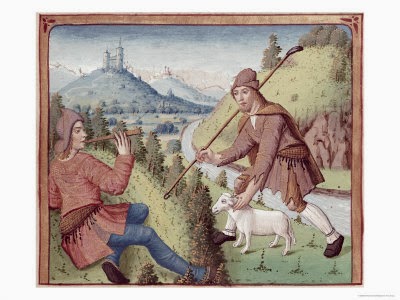
because with three simple words, Horace lays the groundwork for a poem that describes a utopia where a simple rustic tends field and flock, as his ancestors did free of loans and banks. Every tree bears fruit. Sheep and cattle are happy, and the wife ever attentive and dutiful. It’s nice to dream of such a life, Horace, but what is it you want to tell us?

We heard your call in Epode 16 for us to return to a simpler life. Is this poem more of the same? Maybe. Maybe not, for what Horace has written could be taken as the words of the money-lender, who while praising the bucolic life, insists on collecting what is owed him just the same. The money-lender reinforces the myth that a farmer’s life is a happy life. 

A myth? 

No, a lie. 

“You happy folk keep working hard,” says the faenerator, “so that I can take my cut of your hard work. Sorry, but this is the way things are, and a guy’s gotta make a living. Just keep living the lie.” 

Behind this poem of honey and wine and happy cows is an indictment against Roman society, which created a class of people enslaved. In other times, in other places, these people would be described as ‘sharecroppers’ or ‘beholden to the company store’ or ‘drowning in credit card debt.’  


Grammar-wise, this poem is not difficult, if you know Poet-ese. You know: the o’er, the ’twas, the ere stuff we learned in English class. The only trouble is: you have to know what’s considered Poet-ese in Latin. 

In this poem, you will find the accusative plural -is. It is an alternative to the more usual -es and looks a lot like the ablative plural. You have to pound it into your head that the accusative -is only occurs with nouns and adjectives of the third declension. But we are not talking about any third declension word—just those with -i stems such as civis, imber, mons, tristis, ācer, fēlix, ingens, and all the present participles. There are quite a few instances of the accusative -is in today’s epode. I have underlined them and, to make this ending stand out even more, I have done what I usually do: replace the dotted i with an undotted one: ı

It appears that Horace enjoys juxtaposing -ıs with the non poetic accusative plural, which must have pleased his audience greatly:

errantıs greges roaming flocks
infirmas ovıs  unsteady sheep
imbrıs nivesque  rain and snow
obstantıs plagas  opposing traps
dulcıs liberos  sweet children
pastas ovıs  grazing sheep
renidentıs Lares  shining Lares


(You can read more about this annoying variation in my blog of September 23, 2009.) 

Another bit of Poetese is the use of multus to mean ‘many a.’ This occurs in this briar patch of thorny Latin:

aut trudit acrıs hinc et hinc multā cane
      apros in obstantıs plagas

where multā cane means ‘by many a dog.’

Still another poetic/rare construction is found in the lines

quis non malarum, quas amor curas habet, 
      haec inter obliviscitur?

where malarum, the genitive object of obliviscitur, modifies curas, an accusative plural noun. How is this possible? Apparently, according to grammarians, a “noun, when placed after a relative, is sometimes put in the same case with it, though a different case is required by its own connexion” (Karl Zumpf in his A Grammar of the Latin Language, 1832, pg. 237). This verbal mud means that Horace’s lines would become in high-school Latin:

Quis curarum malarum quas amor habet non obliviscitur?
Who does not forget the evil cares which love has?

Now that you see how it works, you could change this sentence:

Hic cani magno quem vides non nocet.
He isn’t hurting the big dog you see.

into (although Zumpf and others warn against any such imitation of the ancient authors) this Latin gem:

Hic magno quem vides canem non nocet.

This grammatical trick serves to add emphasis. Thus our made up sentence might sound like this in English:

He isn't hurting the big one, the dog you see.

And returning to Horace, we might improve our translation with: 

who does not forget about the bad, 
which [are] the worries love makes use of?

Translation ::

Blessèd is he, who far from business deals,
          like the first race of mortal men,
works his father’s lands with his own oxen,
          freed from all the money lending;
no soldier is he, harsh bugle-called,
          no ill-tempered sea does he fear,
but shuns the forum, the haughty doorways
          of city folk more powerful.
In this way, he marries the tall poplars 
        with the mature shoots of grapevines,
or in a far off valley of bawling 
        cattle looks at the errant herds,
or, pruning off the dead branches with a 
        hook, grafts on more rewarding ones,
or stores up extracted honey in clean 
        jars or shears the unsteady sheep;
or, when fall raises its head glorious 
        with ripe fruit above the fields,
how glad he is picking grafted pears and
        the grape vying with purple dye!
He honors you so, Priapus, and you 
        Father Silavanus, keeper 
of the land. It’s a joy to lie under 
        the old oak or in the thick* grass:
meanwhile streams glide by high banks, 
      the birds quarrel in the woodlands, 
and the springs resound with water flowing, 
      [all] to bring about pleasant sleep
But when a wintertime of thundering skies*
      brings on rain and snow, either he
drives wild beasts from here*, from here boars with dogs
    aplenty into snares set up
or with light forked sticks he puts out loose* nets, 
     a trap for voracious thrushes 
and captures in a snare a scared rabbit 
     a migrant crane, happy prizes.
Who amidst all this does not forget about 
      the bad, the cares love holds?
But if a chaste woman loves for her part 
      her home and sweet children, like a 
Sabine or a wife burned dark by the sun 
      of some lively Apulian,
she piles the hallowed fireplace with dry* wood
      at the return of her tired mate
and, shutting the fat* herd in a pen of
     woven brush, drains their hanging teats,
and, bringing out this year’s wines from fresh* jars*, 
      fixes up no store-bought dinner: 
The Lucrine oysters wouldn’t please me more 
      or the turbot, even the wrasse,
should the thundering winter in waves from 
      the east veer them into our sea,
no guinea fowl will descend into my belly,
      no Ionian hazel grouse
more delightful than an olive picked from 
      the fattest* branches of the trees
or meadow-loving sorrel leaves, mallow 
      healthful for the ailing body,
or a lamb killed for the Terminus Day
      or a kid ripped away from a wolf.
How it is a joy while dining to see 
      these sheep having grazed hurry home,
to see the exhausted oxen dragging 
      the upturned plow round their tired necks 
and in any rich house a swarm of slaves*
      seated round the sparkling Lares!
When Money-lender Alfius said this, 
     thinking* he’d be a farmer too,
he called in all the cash on the fifteenth,
     planning to place it on the first.
translation © 2014 by James Rumford

Notes ::

thick : tenaci means ‘tenacious’ and sometimes refers to matted fiber.
skies  : Jove sometimes refers to the sky
beasts : translators take acris as an adjective for apros, but I wonder whether Horace intended this, especially since he separates the two words with et hinc.
loose : rara can refer to something loosely woven as a net.
dry : vetustus means ‘old,’ or as Niall Rudd has translated it ‘seasoned.’ I chose ‘dry’ because it seemed to sound better in the line I had constructed.
fat : laetus usually means ‘happy’ but it can also mean ‘fat’ in reference to cattle. English has its ‘fat and happy.’
fresh : dulcis means sweet, but here I took it to mean ‘fresh’ as in the expression ‘sweet water.’ I suppose that dulcis could also mean ‘fine’ or ‘nice.’
jars : the word is singular in Latin, but since wine was in the plural, I decided to make jar plural, unless the Romans were into wine-blending and put different wines into one jar.
fattest : we don’t use ‘fat’ this way in English but I thought: why not?
slaves : vernas not only means ‘slaves’ but those born to the master’s slaves.
thinking : I think that the verb puto is understood here.

Some Vocabulary ::

propāgine : the first o of propago is either long or short; in its declined form, it is long.
insitiva : grafted
classico : <classicum, trumpett
exercet : <exerceo, to work 
ames -itis : [m] pole for spreading bird nets.
trudit : drive forward
multā : many a [ablative, poetic]  Acronis: Femino genere canem dixit, ut Vergilius: Visaeque canes ululare.
levis : according to the meter, the e must be short, precluding the word lēvis, which means “smooth, flowing.” Levis here must mean the opposite of gravis, that is not heavy or painful or unpleasant.
retia rara : loosely-woven net. I suppose this means that the string is rare, meaning that there is not as much as would be if the net were tightly woven.
turdos : thrushes
crātibus: : wickerwork of some kind
siccet : milks
horna : hic annus
Lucrina : adj. for Lake Lucrinus in Campania
Eois : dawning, of the dawn
attagēn : a meadow-bird, a grouse of some kind
lapathi : sorrel
Terminalibus : the Terminialia, a festival celebrating the god of boundaries, Terminus
vernas : slaves born at their master’s home <verna, ae: masc. or fem.
redegit: called in <redigo, drive back

In Prose ::

“Beatus [est] ille qui procul negotiis, omni faenore solutus, ut gens prisca mortalium, rura paterna bubus suis excercet neque miles classico truci excitatur neque mare iratum horret forumque et limina superba civium potentiorum vitat.

Ergo [ille] aut populos altas prōpagine adultā vitium marītat aut greges errantıs in valle reductā mugientium prospectat, ramosque inutilıs falce amputans, feliciores inserit aut mella pressa [in] amphoris puris condit aut ovıs infirmas tondet.

Vel cum Autumnus caput pomis mitibus decorum agris extulit, ut gaudet pira insitiva decerpens et uvam purpurae certantem, qua muneretur te, Priape, et te pater silvane, tūtor finium.

Libet modo sub ilice antiquā, modo in gramine tenaci iacere: interim aquae ripis altis labuntur, aves in Silvis queruntur fontesque lymphis manantibus obstrepunt, quod somnos levıs invitet.

At cum annus hibernus Iovis tonantis imbrıs nivesque comparat, aut hinc et hinc apros acrıs multā cane in plagas obstantıs trudit aut amite levi retia rāra tendit, turdis edacibus dolos leporemque pavidum et gruem advenam laqueo praemiā iucundā captat.

Quis, inter haec, [curarum] malarum quas [curas] amor habet non obliviscitur? Quodsi mulier pudica in partem atque domum liberos dulcıs iuvet, qualis Sabina aut uxor solibus perusta Apuli pernicis, focum sacrum lignis vetustis sub adventum viri lassi exstruat, pecusque laetum [in] crātibus textis claudens, ubera distenta siccet et vina horna promens, dolio dulci dapes inemptas apparet:

Lucrina conchylia me non iuverint rhombusve magis aut scari, si quos hiems fluctibus Eois ad hoc mare vertat, non avis Afra in ventrem meum descendat, non attagēn Ionicus iucundior quam oliva de ramis pinguissimis arborum aut herba lapathi prata amantis et malvae corpori gravi salubres vel agna festis Terminalibus caesa vel haedus lupo ereptus.

Inter has epulas ut iuvet ovıs pastas domum properantıs videre, boves fessos collo languido vomerem inversum trahentıs videre vernasque positos, examen domūs ditis, circum  Laris renidentıs.”

Ubi Alfius faenerator haec locutus [est], iam iam rusticus futurus, pecuniam omnem Idibus redegit, quaerit Kalendis ponere. 

Original Epode :: [Revised April 14, 2015]

˜ ¯ ˘ ¯ ˜ / ¯ ˘ ¯ ˜ ¯ ˘ ˜
˜ ¯ ˘ ¯ ˜ ¯ ˘ ˜   [iambic strophe]

˜ indicates a long or short syllable and, in some cases, it indicates that various substitutions may occur such as ˘˘. Horace sometimes substitutes ˘˘ for a ¯.

Beātus ille / quī procul negōtiīs,
      ut prisca gens mortālium,
paterna rūra / bōbus exercet suīs
      solūtus omnī faenore
nēque excitātur / classicō mīles trucī
      nēque horret īrātum mare
forumque vītat / et superba cīvium
      potentiōrum līmina.
ergō aut adultā / vītium prōpāgine
      altās marītat pōpulōs
aut in reductā 
valle mūgientium

      prospectat errantıs gregēs
inūtilısque 
falce rāmōs amputāns

      fēlīciōrēs inserit
aut pressa pūrīs / mella condit amphorīs
      aut tondet infirmās ovıs;
vel cum decōrum 
mītibus pōmīs caput

      Autŭmnus agrīs extulit,
ut gaudet insi
/tīva dēcerpēns pira

      certantem et ūvam purpurae,
quā mūnerētur 
tē, Priāpe, et tē, pater

      Silvāne, tūtor fīnium.
libet iacēre 
mōdo sub antīquā īlice,

      mōdo in tenācī grāmine:
lābuntur altīs interim rīpīs aquae,
      queruntur in Silvīs avēs
fontēsque lymphis 
/ obstrepunt mānantibus,
      somnōs quod invītet levıs.
at cum tonantis 
annus hībernus Iovis
      imbrıs nivısque comparat,
aut trūdit acrıs 
hinc et hinc multā cane
      aprōs in obstantıs plagās
aut āmitĕ lĕv
ī / rāra tendit rētia

      turdīs edācibus dolōs
păvĭdum
|quĕ lĕpŏrem | ĕt / ad|vĕnam | lăqueō | grŭem
      iūcunda captat praemia.
quis nōn malārum / quās amor cūrās habet
      haec inter oblīviscitur?
quŏdsī 
pŭdīc|ă / mŭlĭ|ĕr in | partem | iŭvet

      domum atque dulcıs liberōs,
Sabīna quālis
aut perusta Sōlibus

      pernīcis uxor Āpulī,
sacrum vetustīs 
/ exstruat lignīs focum

      lassī sub adventum virī
claudēnsque textīs 
/ crātibus laetum pecus

      distenta siccet ūbera
et horna dulcī 
vīna prōmēns dōliō

      dapēs inemptās apparet:
nōn mē Lucrīna iūverint conchȳlia
      magisve rhombus aut scarī,
sī quōs Eōīs 
/ intonāta fluctibus

      hiems ad hōc vertat mare,
nōn Āfra avis descendat in ventrem meum,
      nōn attagēn Iōnicus
iūcundior quam 
/ lecta dē pinguissimis

      olīva rāmīs arborum
aut her
|ba lăpă|thī / prā|ta amant|is et gravi

      malvae salūbrēs corporī
vel agna festīs 
/ caesa Terminālibus

      vel haedus ēreptus lupō.
hās in|ter ĕpŭ|lās / ut | iŭvat pastāsovıs

      vidē|re prŏpĕ|rantıs domum,
vidēre fessōs / vōmerem inversum bovēs
      collō trahentıs languidō
pŏsĭtōs
|que ver|nās, / dī|tis e|xamen | domūs,

      circum renīdentıs Larıs!
haec ubĭ lōcūtus 
/ faenerātor Alfius,
      iam iam 
| futūr|us rus|ticus,

omnem redēgit / Īdibus pecūniam,
      quaerit Kalendīs pōnere.

Delphin Ordo ::

Felix ille, qui longè à negotiis, et liber ab usuris omnibus, agros paternos colit propriis bobus, sicut homines antiqui: neque bellator excitatur gravi sono tubæ, nec timet procellosum mare: fugit lites et domos superbas opulentorum civium. Itaque vel palmites vitium crescentes alligat excelsis populis, atque steriles surculos falce resecans, fertiliores inserit: vel in remotâ valle pascentes mugientium greges contemplatur; vel extracta favis mella recondit in vasis mundis: vel tondet oves imbecillas. Cùm verò autumnus campis erexit caput dulcibus fructibus ornatum, quàm lætatur colligens pyra insitiva, et uvas purpuræ æmulas, quas tibi offerat, O Priape, tibique, Syvane parens, agrorum custos! Nunc placet recumbere sub annosâ quercu, nunc super herbam virescentem. Interea dum amnis defluit ripis sublimibus, canunt aves in nemoribus; rivulique murmur edunt aquis loquentibus, quod placidum conciliet soporem. Quando autem tempestas hyemalis Jove sæviente pluvias et nives procreat: vel plurimis canibus apros feroces undequaque propellit in retia opposita; vel perticâ lævigatâ plagas haud strictas expandit turdis veracibus insidiosas: ac timidum leporem, gruemque transmarinam prædam jucundam captat. Inter ista quis recordatur molestiarum quas amor gignit? Quòd si casta uxor ex parte suâ curans familiam dilectosque natos (velut Sabina vel conjux Apuli velocis, adusta solis ardore) è lignis aridis componat sacratum focum, paulò sante reditum mariti fatigati; et caulis includens gregem saturum, mulgeat plena ubera; atque vinum hujus anni educena ex amphorâ non insuavi paret cœnam non aliunde quæsitam: haec inquam si adsint, non prætulerim ostrea Lucrina, vel rhombos, vel scaros, si aliquos ex Orientali mari in hoc Italicum protrudat sæva tempestas: nec volucris Africana veniat in meum ventrem, vel attagena Asiana gratior, quàm oliva decerpta è ramis arborum pinguissimis; vel folia rumicis prata amantis, et malvæ salutares ægro corpori, aut agna immolata in sacro die Terminalium, aut hœdus lupo detractus. Inter istam cœnam, quàm jucundum est cernere oves saturas domum revertentes, intueri boves fatigatos languenti cervice inversum aratrum ducentes, et servulos opulentæ familiæ adjunctos velut examen, circa Lares splendentes, ordine dispositos! Postea quàm alphius fœnerator ista dixit, quasi mox rura habitaturus, universam pecuniam Idibus collegit, Calendis verò quærit collocare, ad fœnus.

::


:: Latin books by James Rumford ::


For all 102 odes purchase Carpe Diem, Horace De-Poetizedfor $11.50 at 

For a Latin translation of The Adventures of Tom Sawyer at $12, click here: 

To find out more about Carpe Diem go to the blog of March 26, 2015; 
for more about Pericla Thomae Sawyer, go to the blog of November 22, 2016.


Sunday, February 9, 2014

More Blessèd Shores :: Altera Iam Teritur :: Epode 16


This ode is neither short nor sweet. In 66 complicated lines, Horace foretells doom for Rome, and, like some senator, makes a case for abandoning the City à la Phocaean (an Ionian people who fled their city, leaving it to the Persians). He then offers a greener-hill-lies-yonder solution and like some pastoral poet extols the beauty of sheep in the meadow, grapes on the arbor, and cows a-lowing homeward bound. Horace even goes so far as to say that this will all be possible if Rome follows him and heeds the words of a poet.

I am not sure what to think. Is this Horace making fun of pastoral poems, which seem to say that the shepherd with his lute and a good song can conjure up peace and beauty, refuge and truth? Is he making fun of Virgil, who sometime before this epode wrote his so-called Buccolics or Ecloga? Many a scholar has pointed out that Horace used many of Virgil’s phrases in this poem. In fact, while I was working on this epode, I happened, just by chance, to read Virgil’s Ecloga. The similarities were quite apparent, especially those found in Eclogue IV. 


Why is it that a society craves the comfort food of pastoral poems, of art in general extolling the virtues of a simpler life? America, even in days more rural than ours, needed its Currier and Ives, its James Whitcomb Riley and more recently its Grandma Moses. 


But I think that neither Horace’s nor Virgil’s take on “pastoral” is as sentimental as I make it out to be. Both poets are dealing with huge social issues, which, as Horace warns, may cause Rome to collapse under its own might.

Two notes are necesssary here. 

The first refers to the long a and the short a in Latin (See also my blog posting for January 20, 2013: Ahhhh, Latin). Notice how a solid grasp of the meter is necessary to understanding which a’s are long and which are short in the following three lines:

nec fera caeruleā domuit Germānia pube

novāque monstra iunxerit libīdine

mella cavā mānant ex ilice, montibus altīs

The second is that there seems to be some confusion about where to put these two lines:

nulla nocent pecori contagia, nullius astri
     gregem aestuosa torret impotentia.

Different editors have proposed slipping them in after temperante caelitum, others after viperis humus, still others after cohors Vlixei. I have chosen to follow the arrangement offered in the 2004 edition done by Niall Rudd. Interestingly, Mr. Rudd translated the lines twice and placed them, each worded differently in two different places! Obviously an error—but not the first, unfortunately (See my blog posting for January 31, 2012: Shocked :: Descende Caelo).

Translation :: 

Now another age is wasted by civil wars
And under its own might Rome itself collapses,
which even its Marsi neighbors could not destroy— 
nor menacing Porsena’s Etruscan forces,
nor Capua’s rivaling strength, nor fierce Spartacus
nor the faithless Allobrox in the Great Events*,
nor did wild Germany with its blue youth* subdue
nor Hannibal, a curse to mothers and fathers.
We, an impious age, blood-cursed*, shall lose out
and again our land will be seized by savages*.
Hell! On ash a barbarian victor, will stand!
And Rome—a horseman will jolt with the sound of hooves,
and those Quirinian* bones kept from wind and sun—
a crime to see—he will scatter in arrogance.
What by chance might resolve this for all? The best of 
you at least seek to be free from evil hardship.
Let there be no better resolution than this: 
to go Phocaean-State-like* (under solemn oath  
it fled fields, ancestral gods; it left its temples
to be inhabited by boars, ravenous wolves)
wherever our feet take us, wherever over 
waves the Notus or Africus wind calls up storms*.
So resolved? Or can* anyone give better advice?
Why delay taking the boat under lucky wings*?
Rather let us swear on these things: once stones have swum
up from deep shoals*—let be it no crime to return;
nor should it be shameful to turn the sail homeward, 
once the Po’s washed the heights of Mattinata*
or into the sea have run the high Appenines,
and a strange love has joined monsters with a new lust,
so that the tiger delights in squatting* for deer,
and the dove is defiled by the kite, and, full of 
trust, the cattle does not fear the growling* lions,
and a goat without a beard* loves the salty* seas.’ 
These things and whatever might cut our sweet return
let us go all, a city that has made an oath,
or the part above the unteachable herd. Let them,
soft, hopeless, press themselves into ill-omened beds.
You who have virtue, kill the womanish lament
and fly beyond the shores of Etrusca. Around 
us remains an uncertain ocean: let us head for
the blessèd fields, for the rich fields and the islands,
where the earth yields grain untilled every year
and unpruned blooms the grapevine continually,
and the olive branch, never failing, is fruitful,
and the dark-colored fig adorns the tree; honey
trickles from a hollowed oak, from the high mountains
fast-flowing water dances* down on splashing feet*.
And there unbidden come the she-goats to be milked,
and the kind herd brings back its udders distended
and no evening bear growls around the flock of sheep
nor does the ground begin to swell up with vipers;
happy we marvel at much: how the wet Eurus 
does not with widespread rains lay the sown fields bare,
the fat seeds do not burn up in dry clods of earth,
each heaven’s blessing under a temperate god*.
No contagion does harm to the herd, the summer* 
fury of no star at all leaves the flock baking
not this place did pine ship seek with Argoan* oars,
nor did an impudent Colchian* set feet upon,
not to this place did Sidon’s* sailors turn their sails
nor Ulysses’ comrades beset with hardship.
Juppiter sectioned off that shore for a pious 
race, as he defiled the golden age with bronze,
with bronze then with iron he hardened our race whose 
propitious flight I poet* give to the pious.
translation © 2014 by James Rumford 

Notes ::

in the Great Events: Porphyronis Comm.: Hoc ad tempus illud refertur, quo Catilinae factio coniuravit, et paene legati Allobrugum illis consenserant [This refers to the time when Catiline’s faction made a pact, and the envoys of the Allobruges nearly agreed to it.] Acronis Comm.: novisque rebus. magnis…
In 63 BC, Catiline planned a coup d’état. He sought the help of a Gaullish tribe, the Allobruges, and formed a pact with them. They, however, betraying Catiline and going back on their word, informed Cicero of the coup d’état and the res magnae, which I shall call ‘The Great Events of 63’ came to an end.
blue youth:  The ancient commentators say that ‘blue’ refers to the color of the Germans’ eyes. I wonder, too, if blue didn’t refer to the fact that various tribes dyed their skin blue. Was Horace confusing Germans with Picts? Often scholars point out that Horace cared more about the meter than he did with facts. 
blood-cursed:  Devoti has many meanings ranging from the usual meaning in English to ‘cursed’ with the idea that one makes a vow or devotes oneself to the infernal gods.
savages: Feris usually refers to wild animals like lions, but it can also describe human beings. Although I chose to translate feris as ‘by savages’, given what follows in the next line, I wonder whether Horace didn’t mean both man and beast.
Quirinian bones: Apparently this refers to the bones of Romulus.
Phocaean-State-like: Phocaeorum velut looks as if it will introduce a complex sentence. Instead, the sentence that follows seems truncated. So, I made up an adverb: Phocaean-State-like. Is that what Horace was doing in Latin? Most editors see this bit about the Phocaeans as a parenthetical remark. 
storms: Some editors read the text as protervos because the winds Notus and Africus will call up violent ones, i.e., storms. Other editors view protervus as an adjective for Africus. I wonder what Horace was thinking. To him the Notus was violent. Maybe the Africus was not as violent and needed protervus to give it some oomph. Personally, I like protervos; it makes more sense to give vocabit an object: [ventos] protervos.
can: Habet + infinitive sometimes has the meaning ‘to be able to.’
under lucky wings: Secunda alite was part of the whole auspicious (avis-spicere) bird-watching thing that helped the Romans foretell the future. Alite ‘winged’ is poetic for ‘bird.’ Horace will use secundus again at the end of the epode.
if ever stones swim up from deep shoals: The words simul, renarint, and vadis are each given special meanings in the Lewis and Short dictionary so that the line makes sense. Instead of following the dictionary and the commentators, I have chosen to give the most common meanings, even if imis vadis produces a quasi oxymoron. (Vadis, by the way, is distantly related to our word ‘wade.’) What follows is a very Greek way of formulating an oath called adynata, impossibilities. In other words, since stones can’t ever rise meaning that any return is out of the question. 
Mattinata: In the Parco Nazionale del Gargano is a promonitory 260 ft above the Adriatic known to the Romans as Matīnus.
squatting: Although, in citing this poem, Lewis and Short define subsido as a female animal submitting to a male, I prefer the basic meaning of the verb, which is to sit down, crouch down, and squat. These better describe the act.
growling: Rāvus has two meanings: the usual ‘yellow-grey’ and a very rare one ‘hoarse.’ I would think that Horace would rather talk about what makes the lion frightening than what color coat it has.
beard: Lēvis means ‘smooth, beardless.’ Since Horace is talking about impossible things, to him a beardless goat is an impossibility. Interestingly, levis with a short e means ‘light, weightless.’ Although he could not use levis due to the constraints of the meter, his listeners or readers must have liked this play on words.
leaping: Salsus means ‘salty’ and comes from salio, meaning ‘to salt.’ There is another salio, which means ‘to leap.’ I can’t help thinking that this is another play on words like lēvis/levis.
dances: Desilit means ‘leaps down.’ Even so, my mind conjured up salto, ‘to dance,’ which surely must be related etymologically. 
feet: In Latin water has feet. Would we say ‘fingers of water’ making their way down the mountain or across a field? 
Argoan: I made up this adjective in English to refer to the Argonauts.
Colchian: This refers to Colchis, a province east of the Black Sea and by extension to Medea. Lewis and Short say this about Medea: 
Μήδεια, a celebrated sorceress, daughter of Æetes, king of Colchis. She assisted her lover, Jason the Argonaut, in obtaining the golden fleece, accompanied him to Greece, and prevented her father, who was in pursuit, from overtaking them, by strewing the sea with her brother's limbs. When Jason afterwards repudiated her, in order to marry Creusa, she killed the children she had had by him, and burned the bride to death in her palace 
Sidon’s: Sidon refers to the city in Phoenicia and by extension Sidon is poetic for Phoenicia.
god: King is meant here but the reference is to Juppiter which is further indicated by caelitum, ‘something from heaven.’
summer: Aestuosus, ‘fiery, hot’ comes from aestus, ‘fire, heat.’ The word is so close to aestas, ‘summer,’ and aestivus, ‘summery,’ that I couldn’t help fudging a bit here.
poet: Vates means ‘prophet,’ ‘seer,’ and by extension ‘poet.’ My guess is that Horace wants to be all three. What is more, editors sometimes set off vate me with commas so that it is clear that these two words should be treated as an ablative absolute, producing a cumbersome ‘since I am a prophet’ or ‘with me as seer.’ I simply chose to ignore all of that, including the fact that the sentence is passive with no clear actor. I think making the verb active with I as the subject is more forceful in English and translates the spirit of what Horace has said: he alone is the mouth-piece of the state, the poet-propagandist who will lead Rome to safer more blessed shores.  

In Prose ::    

     Aetas altera iam bellis civilibus teritur et Roma ipsa viribus suis ruit, quam [1] neque finitimi Marsi aut [2] manus Etrusca Porsenae minacis perdere valuerunt, nec [3] virtus aemula Capuae nec [4] Spartacus acer [5] Allobroxque infidelis rebus novis nec [6] Germania fera pube caeruleā domuit [7] Hannibalque parentibus abominatus.
    [Nos], aetas impia sanguinis devoti, perdemus, solumque feris rursus occupabitur.
    Victor barbarus heu cineres insistet, et eques ‹ungulā sonante› Urbem verberabit, quaeque ossa Quirini ventis et solibus (nefas videre) insolens dissipabit.
aut quid pars melior forte communiter expediat, quaeritis laboribus malis carere; nulla sententia hac potior sit: velut civitas exsecrata Phocaeorum agros profugit atque lares patrios fanaque apris et lupis rapacibus habitanda reliquit, ire quocumque pedes ferent, quocumque Notus aut Africus protervos vocabit.
    Sic placet? An melius quis habet suadere? Quid [nos], alite secundā, ratem occupare?
       Sed in haec iuremus: ‘simul [1] saxa [a] vadis imis levata renarint, ne nefas redire sit; neu pigeat domum lintea conversa dare, [2] quando Padus cacumina Matina laverit, [3] seu Appenninus celsus in mare procurrerit [4] amorque mirus, monstra nova libidine iunxerit, ut iuvet tigris cervis subsidere, et columba miluo adulteretur, [5] nec armenta credula leones ravos timeant [6] hircusque lēvis aequora salsa amet.’
     Et haec exsecrata [sunt] quae [nostros] reditūs dulcıs abscindere poterunt, [nos] civitas omnis eamus, aut pars melior grege indocili; [aut pars] mollis et exspes cubilia inominata perpremat.
     Vos, quibus est virtus, luctum muliebrem tollite, et prater litora Etrusca volate.
     Oceanus vagus circum nos manet: arva beata petamus, arva divites et insulas, reddit ubi [1] tellus inarata cererem quotannis reddit et [2] vinea imputata usque floret, et [3] numquam termes olivae fallentıs germinat [4] ficusque pulla arborem suam ornat, [5] mella ex ilice cavā manant, [6] lympha levis [in] montibus altis ‹pede crepante› desilit. 
     Illic capellae iniussae ad mulctra veniunt grex amicus ubera tenta refert nec ursus vespertinus ovile circumgemit nec humus alta viperis intumescit; [nos]que felices plura mirabimur, ut neque Eurus aquosus arva imbribus largis radat, nec semina pinguia glaebis siccis urantur, utrumque caelitum rege temperante.
     Nulla contagia pecori nocent, impotentia aestuosa nulius astri gregem torret.
       Non huc pinus Argoo remige contendit neque Colchis impudica pedem intulit, non huc nautae Sidonii cornua torserunt, nec cohors laboriosa Ulixei.  
    Iuppiter illa litora genti piae secrevit, ut tempus aureum aere inquinavit, aere, dehinc saecula ferro duravit, quorum fuga secunda piis datur, me vate.

Delphin Ordo ::

Secunda jam ætas absumitur bellis civilibus, et Romam propria disperdit potentia. Quam labefactare nequiverunt Marsi vicini, vel Thuscus exercitus superbi Porsenæ; nec invida Capuæ vis; nec ferox Spartacus; atque Allobroges perfidi, rebus novis studentes, nec vicit trux Germania juvenibus cæruleis; et Annibal parentibus execrabilis; scilicet hanc pessumdabimus ipsi nos homines conscelerati, quorum addictus est cruor: atque terra hæc à bestiis iterum tenebitur. Eheu! victor barbarus stabit super favillas urbis, et equorum pedibus strepentibus conculeabit. Et, quod horrendum visu, ossa Romuli solis ac venti expertia disperget superbus. Forte universi vel pars major interrogabitis quid utile sit ad evitandas tales ærumnas? Nulla videatur sententia melior quàm hæc: opportet abire quocunque ferent pedes, quocunque per mare impellet Auster vel Africus vehemens: quemadmodum Phocæorum urbs post execrationes abscessit, suas domos agrosque et templa dimittens occupanda apris et lupis voracibus. Ita censeo. Habetne quispiam melius aliquid proferre? Quid tardamus navim conscendere faustis avibus? At priùs  jurejurando nos obstringamus, in hæc verba: nec reverti liceat, nisi cùm emergent lapides aquis profundis elati: neve displiceat vela facere versùs patriam, quando Padus rigabit verticem Matini montis, aut altus Apenninus in mare proruet, atque amor prodigiosus insolitâ libidine copulabit geras, adeò ut tigrides cupiant jungi cervis, et columba milvio; atque greges sine metu credant se leonibus fulvis, glaberque fiat caper, et gaudeat mari salso. Posteaquam ista et quæcunque valebunt tollere spem gratam remigrandi adjuraverimus, proficiscamur omnes, aut pars melior plebe indocili. Pars autem iners et spe carens occupet semper hæc domicilia inauspicata. Vos præditi virtute, fœmineo abstinete ejalatu, et properate ultra Thuscum littus. Nos expecta Oceanus circumfluens. Eamus in terram felicem et insulas beatas, ubi solum incultum fert messem annis singulis, et vitis non recisa nihilominus florescit; atque ramus oleæ nunquam non germen et fructum producit, et ficus matura propriam arborem exornat: mel fluit è cavatâ quercu: acqua leniter obmurmurans dimanat è montium cacumine. Ibi capræ sponte veniunt ad mulctram, et grex benignus reportat plena ubera; non ursus vespere fremit circum caulas: nec terra viperarum latebris assurgit aut fit tumida. Ibi nulla gregem lues infestat, nec adurit æstus vehementior ullius sideris. Plura verò beati cum admiratione videbimus, ut quòd Eurus nimbosus agros non infestet nimiis pluviis, neque semina opima urantur, vel arescant glebæ; quippe cœlitum rex utrobique temperiem dat. Illuc non accessit navis remigibus Argois; nec obscœna Colchis gressum infixit. Eò non appulerunt Sidonii, vel ærumnosi comites Ulyssis. Scilicet Jupiter eas insulas reservavit piis hominibus, ex quo ætatem auream ære fœdavit, ac deinde ferro sæcula induravit. Istorum malorum fuga prospera bonis conceditur, me vaticinium edente.
  
Original Epode ::

 Altera iam teritur bellis civilibus aetas,
      suis et ipsa Roma viribus ruit.
quam neque finitimi valuerunt perdere Marsi
      minacis aut Etrusca Porsenae manus,
aemula nec virtus Capuae nec Spartacus acer
      novisque rebus infidelis Allobrox
nec fera caeruleā domuit Germānia pube
      parentibusque abominatus Hannibal:
inpia perdemus devoti sanguinis aetas
      ferisque rursus occupabitur solum:
barbarus heu cineres insistet victor et Vrbem
      eques sonante verberabit ungula,
quaeque carent ventis et solibus ossa Quirini,
      (nefas videre) dissipabit insolens.
forte quid expediat communiter aut melior pars,
      malis carere quaeritis laboribus;
nulla sit hac potior sententia: Phocaeorum
      velut profugit exsecrata civitas
agros atque lares patrios habitandaque fana
      apris reliquit et rapacibus lupis,
ire, pedes quocumque ferent, quocumque per undas
      Notus vocabit aut protervos Africus.
sic placet? an melius quis habet suadere? Secunda
      ratem occupare quid moramur alite?
sed iuremus in haec: ‘simul imis saxa renarint
      vadis levata, ne redire sit nefas;
neu conversa domum pigeat dare lintea, quando
      Padus Matina laverit cacumina,
in mare seu celsus procurrerit Appenninus
      novāque monstra iunxerit libīdine
mīrus amor, iuvet ut tigris subsidere cervis,
      adulteretur et columba miluo,
crēdula nec rāvōs timeant armenta leōnēs
      ametque salsa lēvis hircus aequora.’
haec et quae poterunt reditūs abscindere dulcıs
      eamus omnis exsecrata civitas
aut pars indocili melior grege; mollis et exspes
      inominata perpremat cubilia.
vos, quibus est virtus, muliebrem tollite luctum,
      Etrusca praeter et volate litora.
nos manet Oceanus circum vagus: arva beata
      petamus, arva divites et insulas,
reddit ubi cererem tellus inarata quotannis
      et inputata floret usque vinea,
germinat et numquam fallentis termes olivae
      suamque pulla ficus ornat arborem,
mella cavā mānant ex ilice, montibus altis
      levis crepante lympha desilit pede.
illic iniussae veniunt ad mulctra capellae
      refertque tenta grex amicus ubera
nec vespertinus circumgemit ursus ovile
      nec intumescit alta viperis humus;
pluraque felices mirabimur, ut neque largis
      aquosus Eurus arva rādat imbribus,
pinguia nec siccis urantur semina glaebis,
      utrumque rege temperante caelitum.
nulla nocent pecori contagia, nullius astri
      gregem aestuosa torret impotentia.
non huc Argōō contendit remige pinus
      neque impudica Colchis intulit pedem,
non huc Sidonii torserunt cornua nautae,
      laboriosa nec cohors Vlixei.
Iuppiter illa piae secrevit litora genti,
      ut inquinavit aere tempus aureum,
aere, dehinc ferro duravit saecula, quorum
      piis secunda vate me datur fuga.


:: Latin books by James Rumford ::


For all 102 odes purchase Carpe Diem, Horace De-Poetizedfor $11.50 at 

For a Latin translation of The Adventures of Tom Sawyer at $12, click here: 

To find out more about Carpe Diem go to the blog of March 26, 2015; 
for more about Pericla Thomae Sawyer, go to the blog of November 22, 2016.